




































Kathmandu: Nepal’s academic competition landscape is undergoing a structural shift as the
Global Math Debate League (GMDL) completes its Lumbini Regional Round, following earlier
rounds in Jhapa and Chitwan. The circuit will now move forward to Pokhara and Kathmandu,
marking a staged national rollout of what organizers call the country’s first platform dedicated to
debating mathematics rather than merely solving it.
The initiative is led by education organization Embark UnMath, which is attempting to reposition
mathematics from a silent procedural exercise into a discipline of reasoning, argument, and
intellectual defense. Instead of racing to produce answers, students must justify assumptions,
critique competing logic, and respond to counter arguments in real time; a format closer to
academic peer review than classroom testing.
Challenging the Memorization Model: For decades, Nepal’s school system has rewarded
accuracy and speed whereas the league challenges that paradigm by rewarding clarity of thought.
Participants research mathematical claims, build logical cases, present structured arguments,
and engage in rebuttal rounds. Judges evaluate reasoning depth, coherence, adaptability, and
collaboration; competencies typically associated with higher education and professional
problem-solving environments rather than secondary school competitions.
Embark UnMath states the league is designed to address a recurring national issue: students can
compute, but struggle to explain. The debate format forces articulation, exposing understanding
gaps while strengthening conceptual ownership.
Lumbini World School as Co-Organizing Partner: The Lumbini regional round was co-
organized by Lumbini World School, handling academic operations and on-ground execution.
The partnership demonstrated that schools can operate as implementation partners rather than
passive hosts, an important proof of feasibility for scaling the model nationwide.
Educators observing the event noted the competition required students to defend logic under
scrutiny; a skill rarely cultivated in conventional exam settings.
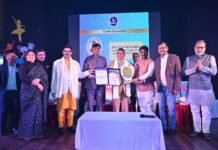
Regional Champions and Qualifiers: After multiple elimination stages, the Lumbini region
produced three winning teams. The team regional champions were Asia Belbase, Manavi Khanal
and Riona Udaya of Alpha Group Qualifiers from Lumbini World School; Asa Pandey, Samip
Neupane and Agrima Adhikari of Beta Group Qualifiers from New Horizon English Boarding
Secondary School. Similarly, Prastuti Nepal, Samragi Belbase and Prekshya Khanal are the team
members of the National Round Qualifier.
Judges reported that the winning teams stood out not only for correctness but for adaptability; the
ability to refine arguments when challenged rather than repeating prepared solutions. Students
who qualified in the Regional Round will advance to compete in the National Round, scheduled
to be held on February 22 nd at 'The Plaza'.
A Potential Shift in Assessment Culture: The significance of the league lies less in trophies and
more in methodology. Nepal’s education system has historically prioritized final answers; the
league prioritizes justification. If widely adopted, such formats could push classrooms toward
reasoning-based evaluation without waiting for policy reform.
With Jhapa, Chitwan, and now Lumbini completed; and Pokhara and Kathmandu next; the
competition is evolving from an experiment into a structured national academic circuit. The
question now is not whether students can calculate, but whether they can be convinced. The
league is betting that future education; and future careers; will require both.